

I have a friend, Rich Washburn, and we have been discussing, arguing, and prophesying about AI since 2012.
Long before the current wave of large language models, we were already talking about what machine intelligence might become, where it could go, and how much of science fiction would eventually turn into ordinary reality. When the LLM boom arrived, it felt like part of that future had finally stepped out of theory and into daily life.
In many ways, it has been an amazing journey and a very special time to be alive.
One thing Rich and I both agree on is that AI is still a tool. A powerful one, yes. But still a tool. And like any serious tool, it only delivers its full value when you design your workflow around it and use it deliberately.
That is exactly why I think we need to be more honest about one of AI's hidden risks.
AI can make you faster. It can make you more productive. It can also make it easier to stop thinking as deeply as you used to.
That is the part of the conversation I think we still understate.
The habit problem
The deeper risk is not some instant drop in intelligence. The real problem is that AI can quietly weaken the habits that keep people sharp: wrestling with ambiguity, forming a first-pass judgment, remembering what they learned, checking their own reasoning, and staying mentally engaged long enough to build genuine understanding.
There is a name for this: cognitive offloading.
What cognitive offloading means
It means handing more of the mental work to an external system and doing less of it yourself. In small doses, that is nothing new. We have always offloaded cognition to calendars, calculators, maps, and search engines. But generative AI goes much further. It does not just store or retrieve information. It drafts, summarizes, structures, suggests, rewrites, and increasingly performs parts of the thinking process itself. That can shift a person's role from thinker to reviewer far more often than they realize.
What the research shows
Microsoft Research published one of the clearest studies on this in 2025. Surveying 319 knowledge workers across 936 real-world examples of generative AI use, the researchers found that higher confidence in AI was associated with less critical-thinking effort, while higher confidence in one's own abilities was associated with more critical-thinking effort. They also warned that when routine cognitive work becomes increasingly automated, people can become less practiced and less prepared when exceptions arise.
That resonates with me because I have felt versions of it myself.
One of the first times it really hit me was when I used an LLM to help with disaster recovery documentation. For that particular task, it felt like a superpower. It probably increased my productivity tenfold. The structure came quickly, the language was polished, and the work moved faster than it would have otherwise.
That is the upside, and it is real.
But I have also gone down the rabbit hole many times while planning with AI, only to realize later that speed was creating the illusion of understanding. The output kept expanding. It became fluffier, more verbose, more tangent-heavy, and less useful. What I actually needed was a narrower lane, a more concise answer, and more discipline in how I directed the system. AI was happy to keep generating. The harder part was knowing when the output had stopped getting better and had simply gotten longer.
AI can make a person feel intellectually productive before they are intellectually clear.
Polished, but not yours
There is also another version of the problem that shows up in writing and knowledge work. In a bind, I have sometimes turned to AI to produce work quickly. Then later, when I had time to review it, I could immediately feel the gap. It was polished, but it was not me. My voice was missing. My insights were missing. In some cases, the framing was misaligned with what I actually thought. It looked more like AI slop than work I would normally produce. And the deeper problem was that I had not been sufficiently involved in the research and reasoning process, so at the end I had less ownership of the result and, in some cases, had not really learned much myself.
That is where the balancing act becomes very real.
There is a difference between using AI to accelerate your thinking and using it to replace too much of it.
The research points in the same direction. The Microsoft study found that generative AI often shifts human effort away from direct creation and toward verification, integration, and oversight. That can be useful. But it also means the human may be practicing less of the underlying thinking that once built expertise through repetition.
There is also emerging evidence that the issue may run deeper than workflow habits alone. An MIT Media Lab study posted to arXiv in 2025 found that participants using ChatGPT for essay-writing tasks showed weaker brain connectivity than groups using search engines or no external tools, and reported lower ownership of their work. The authors described this pattern as a form of "cognitive debt." That study is early and has attracted methodological criticism, so it should be treated as suggestive rather than definitive. Still, it adds weight to the broader concern that convenience can reduce the amount of effort people invest in learning and reasoning.
Partner or substitute
AI can be a thinking partner, or it can become a thinking substitute.
Used well, it can challenge assumptions, accelerate iteration, and push work forward. Used poorly, it becomes a shortcut around the very cognitive friction that helps people learn, remember, and develop judgment. That is where the long-term cost starts to show up — not in one dramatic moment, but in small repeated acts of mental outsourcing.
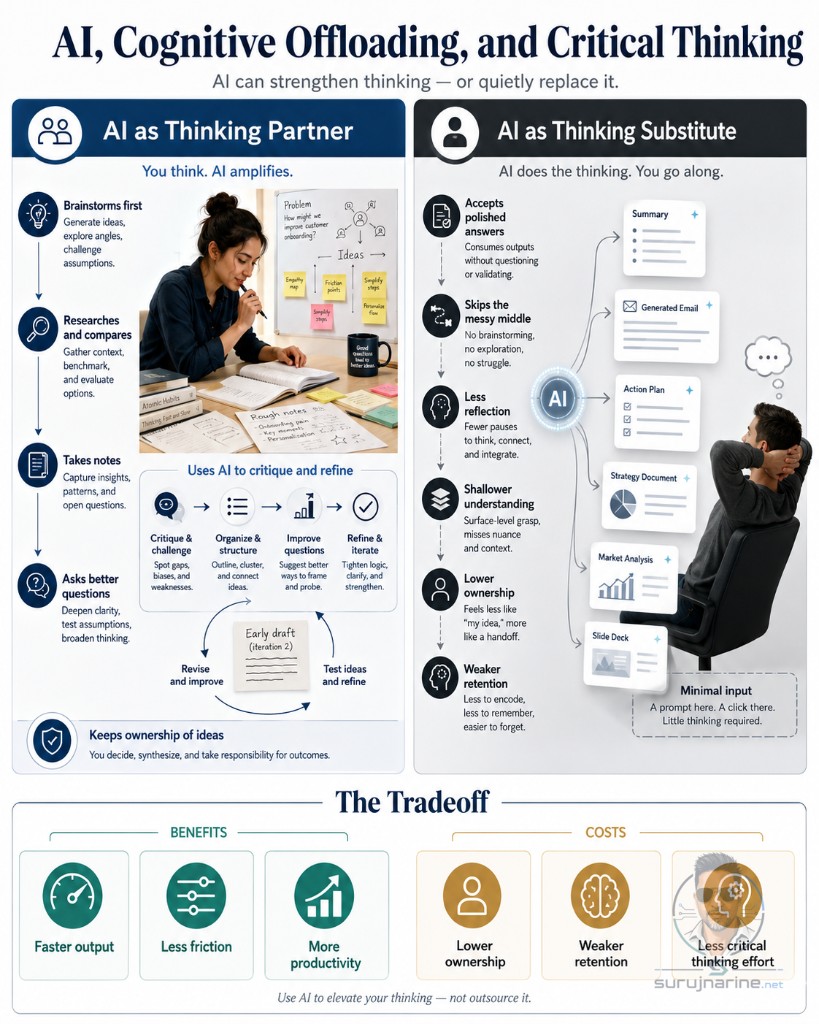
This also helps explain why AI can leave people feeling simultaneously more productive and less mentally engaged.
- You produce more.
- You decide less.
- You finish faster.
- You own less of the thinking.
That tradeoff may be acceptable in some situations. It becomes much more dangerous in others.
If the task is low-stakes, repetitive, or administrative, offloading it may be exactly the point. But if the task depends on judgment, creativity, synthesis, memory, or decision quality, then too much cognitive outsourcing becomes a real cost. That is especially true for people still building expertise. The more someone skips the struggle phase, the less likely they are to develop the depth that real mastery requires.
Reading as a counterweight
One of the reasons this topic has become more personal for me is that it pushed me in the opposite direction: I realized I needed to read more, especially physical books. That insight became part of the reason I started building DistilledReads.com, a site where I'll share short reviews of books I've read, what I took away from them, and longer pieces about reading itself.
Part of the motivation is simple: I wanted to create an incentive to keep reading.
The more I thought about AI and cognitive offloading, the more I felt the need for a counterweight. Reading slows me down in a useful way. It forces me to stay with ideas longer, build my own understanding, and engage with source material directly rather than relying on a polished summary. Research supports that instinct. Reading has been linked to important cognitive benefits, and regular reading activity has even been associated with lower long-term cognitive decline in older adults. Other work has shown that reading supports brain structural and functional development, and that richer engagement with text and prior knowledge improves comprehension and memory.
At the same time, AI is making it easier for people to outsource more of the reading and research process. The evidence does not cleanly prove a headline like "AI is making everyone read less," but it clearly points in a related direction. Microsoft Research found that generative AI often shifts people away from direct creation and toward review and oversight, while the 2025 MDPI study linked heavier AI use to cognitive offloading and reduced critical-thinking performance. Student surveys also show how widespread this shift has become: HEPI found that by 2025, 92% of students were using generative AI in some form, with many using it to explain concepts, summarize articles, and suggest research ideas. Separate consumer survey data suggests many people are also using AI for quick facts and summaries while relying less on traditional search.
That is exactly why I wanted DistilledReads to exist. It is a public project, but it is also a discipline. I want to keep reading, keep thinking, and keep engaging with ideas in a way that requires more than prompting and approving. Our brains work best with varied inputs, not just one conversational interface. If all we do is chat with AI, we risk narrowing the way we learn. Reading is one of the ways I want to guard against that.
That is why I do not think the right response is to reject AI.
The right response is to use it in ways that protect thinking rather than replace it.
A better workflow
A few principles matter here:
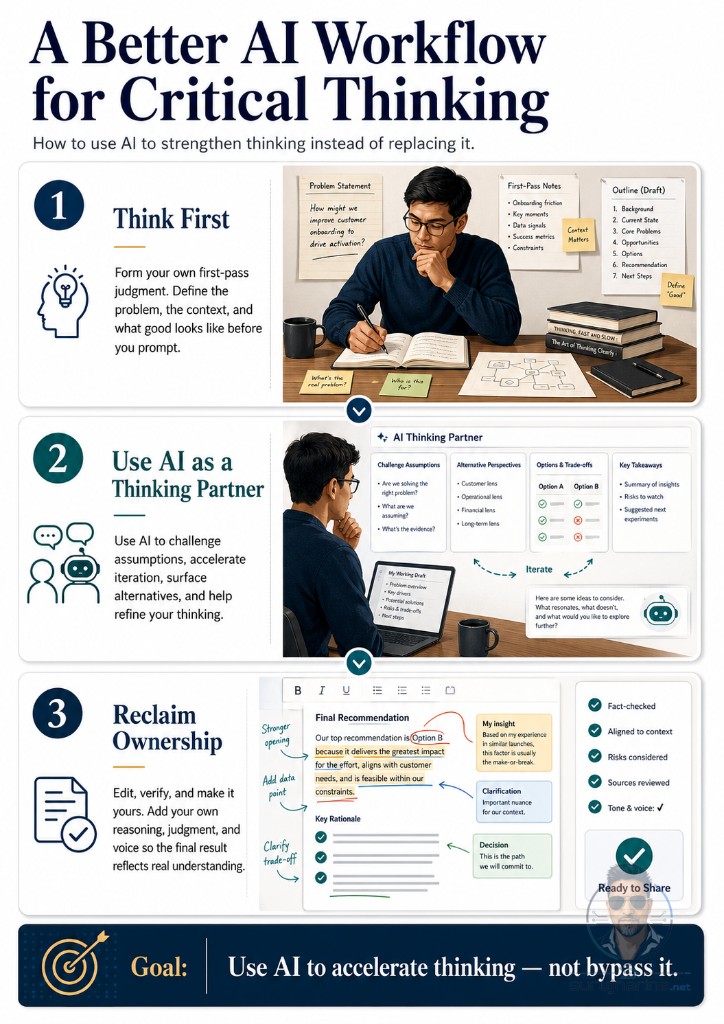
- think before prompting
- form a first-pass judgment before asking for one
- use AI to critique your reasoning, not just generate a substitute for it
- verify more when the stakes are high
- keep some tasks intentionally human-first
- continue reading, researching, and learning outside the prompt box
Those habits matter because once a tool becomes very good at doing parts of your thinking for you, protecting your own ability to think becomes part of the job.
Defend the skill
That, to me, is the real issue.
AI will not make everyone stupid.
But it can make people mentally passive if they are not careful.
And in a world where the tools keep getting better, critical thinking is no longer just a nice skill to have.
It is a skill you may have to defend.
References
- Microsoft Research — The Impact of Generative AI on Critical Thinking
- MDPI — AI Tools in Society: Impacts on Cognitive Offloading and the Future of Critical Thinking
- MIT / arXiv — cognitive effects in AI-assisted writing (cognitive debt; early study)
- HEPI — Student Generative AI Survey 2025
- Equativ — consumer survey on AI replacing some search behavior and use for quick facts/summaries.
- NIH / PMC — reading activity and reduced long-term cognitive decline in older adults
- NIH / PMC — reading, brain development, and cognitive function
- Beckman Institute / University of Illinois — reading for pleasure and stronger memory in older adults.
Related reading
What Cursor's hypergrowth really teaches us
A case study in timing, workflow ownership, enterprise conversion, and execution speed behind Cursor's rise.
The AWS Outage Is a Reminder That the Cloud Still Has a Physical Layer
Heat, power, and cooling in Northern Virginia — why cloud resilience must be tested against physical reality, not just diagrams and failover plans.