
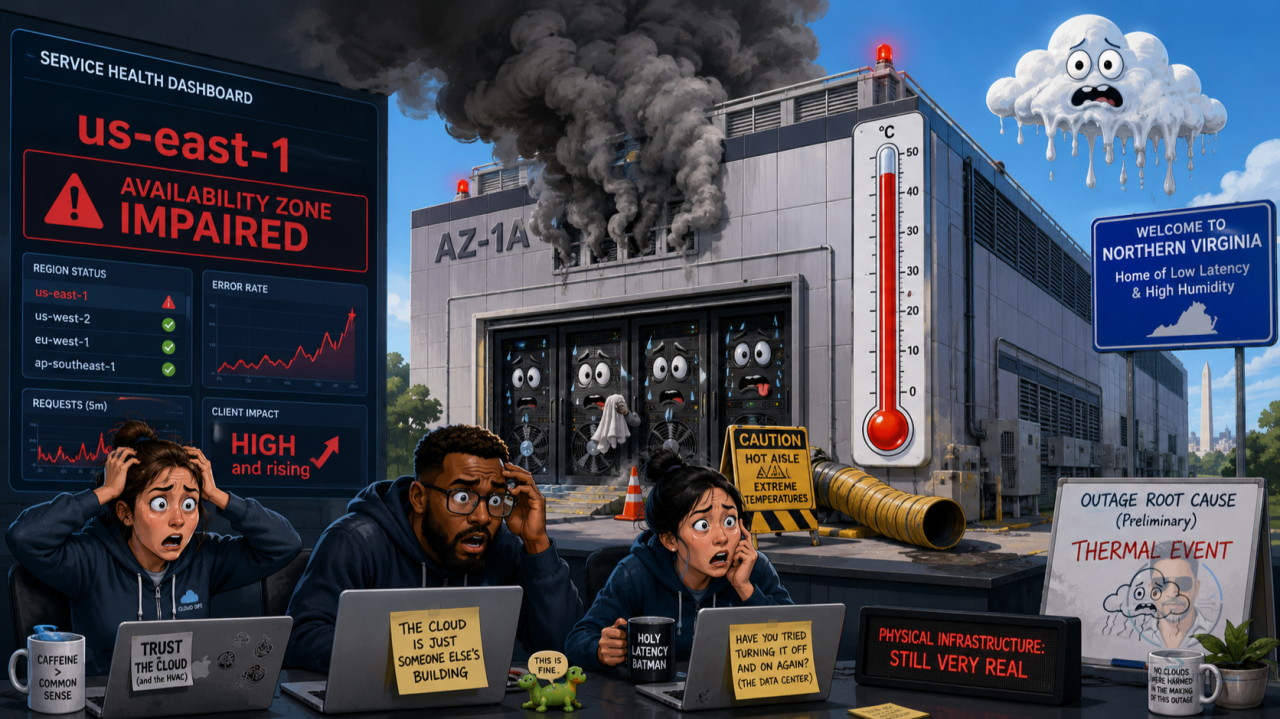
The AWS Outage Is a Reminder That the Cloud Still Obeys Physics
There is a particular kind of false comfort that comes with cloud computing.
When everything works, the cloud feels abstract. Elastic. Borderless. Almost detached from the physical world.
Then an outage like this happens, and reality comes rushing back.
This week's AWS disruption in Northern Virginia appears to have started with something very old-fashioned: heat. Reuters reported that a rapid temperature spike at a single AWS data center knocked out power and disrupted services, including Coinbase, before AWS gradually restored systems and brought additional cooling capacity online. Network World's reporting, based on AWS health updates, said the affected zone was use1-az4, where EC2 instances and EBS volumes on impacted hardware were impaired after a thermal event caused loss of power.
That detail matters.
Because a lot of cloud conversations still happen as though infrastructure risk lives entirely in architecture diagrams, failover plans, and service dependencies. Those things matter, of course. But underneath every region, availability zone, and managed service is a very physical stack: buildings, power, cooling, airflow, hardware density, and operational limits. This incident is a reminder that the abstraction layer only goes so far when the facility underneath it is under stress. AWS reportedly shifted traffic away from the impacted zone for most services, but customers still saw impairments, elevated latencies, and longer-than-usual provisioning times while recovery continued.
That is the part I think technology leaders sometimes underweight.
We talk a lot about multi-cloud. We talk a lot about resilience. We talk a lot about shared responsibility. But outages like this are a reminder that the cloud is still a machine room somewhere, with all the same constraints that have always haunted infrastructure at scale. The difference now is that when one of those constraints breaks at hyperscale, the blast radius stretches across exchanges, sportsbooks, apps, platforms, and enterprise workloads in seconds. Reuters noted that outage reports dropped significantly as recovery progressed, but the incident still hit high-profile customers and highlighted the broader overheating challenge facing modern data centers.
And that broader challenge is where this gets even more interesting.
Reuters explicitly tied the outage to a bigger industry problem: advanced AI and cloud servers consume massive amounts of power and generate intense heat, which is pushing operators toward water cooling and specialized coolants that are far more efficient than traditional air cooling. In other words, this is bigger than one unlucky day in Northern Virginia. As compute density rises, thermal management becomes more strategic. The physical layer starts to matter more, not less.
That should get the attention of every CIO, cloud architect, and platform leader.
Because the lesson here is not simply "AWS had an outage."
The deeper lesson is that resilience assumptions have to be tested against physical reality.
A single impaired availability zone in a core region should not be enough to seriously disrupt a mission-critical service if the system has truly been designed for failure. Yet Network World's coverage points to a familiar pattern: one zone suffers a physical event, dependent services inherit the pain, and customers are left deciding whether their redundancy was real or mostly theoretical. The article quotes analysts stressing that enterprises should verify whether availability zones are truly physically distinct and whether databases and other dependencies are as redundant as the app layer.
That is where a lot of organizations still get caught.
They think they designed for high availability because they spread application instances across zones. But if the data layer, storage patterns, recovery procedures, or failover orchestration are weaker than the diagram suggests, the redundancy is incomplete. When a thermal event turns into a power event, incomplete redundancy gets exposed very quickly.
A few lessons for CIOs and architects
Availability zones are a resilience layer, not a magic shield.
This incident reportedly centered on use1-az4, and AWS shifted traffic away from the affected zone for most services. Even so, dependent services still experienced impairments. That is a reminder that AZ design helps, but it does not remove concentration risk.
Physical-layer failures deserve the same seriousness as software failures.
Power, cooling, and facility design now belong much more visibly in cloud risk conversations. Analysts quoted by Network World explicitly said resilience planning should extend beyond software and cyber risk to physical-layer disruptions as well.
AI infrastructure growth is raising the stakes.
As Reuters noted, AI and cloud servers demand more power and produce more heat. That means thermal risk is becoming a more strategic variable in infrastructure planning.
Mission-critical workloads need harsher failure assumptions.
If one affected zone can create a meaningful customer incident, it is worth asking whether recovery design, data replication, and operational playbooks are truly aligned with business continuity expectations. Network World's coverage specifically highlighted the need to reassess regional concentration risk and validate whether resilience posture matches those expectations.
Cloud abstraction can hide fragility until the worst possible moment.
The cloud feels clean and infinite right up until a building overheats. Leaders should remember that "virtual" resilience still rides on physical infrastructure.
For me, that is the real story here.
This was not just a bad day for one AWS availability zone. It was a sharp reminder that the cloud economy still rests on the oldest constraints in infrastructure: heat, power, cooling, and the engineering discipline required to manage them. In a world where AI is driving more density, more energy consumption, and more thermal stress into the same facilities, those constraints are moving closer to the center of the technology conversation.
The cloud may feel abstract.
Its failure modes still obey physics.
Topics: AWS, cloud outage, cloud computing, cloud resilience, cloud architecture, enterprise architecture, CIO, business continuity, infrastructure, technology leadership.
References
- Yahoo Finance / Reuters— Amazon cloud outage at Northern Virginia data center; recovery and cooling context.
- AWS Health Dashboard— Service health updates (May 2026 incident window).
- Network World— US-East-1 outage after data center thermal event; use1-az4 and dependency patterns.
- ITPro— What happened, who was impacted, and service restoration notes.
- AWS News Blog— New Availability Zone in Maryland for US East (Northern Virginia).
Related reading
The Hidden Cost of AI: Cognitive Offloading
AI can accelerate thinking or quietly replace it — on cognitive offloading, critical thinking, and habits worth defending.
What Cursor's hypergrowth really teaches us
A case study in timing, workflow ownership, enterprise conversion, and execution speed behind Cursor's rise.