

There are startup success stories, and then there are moments that make the rest of the software industry stop and stare.
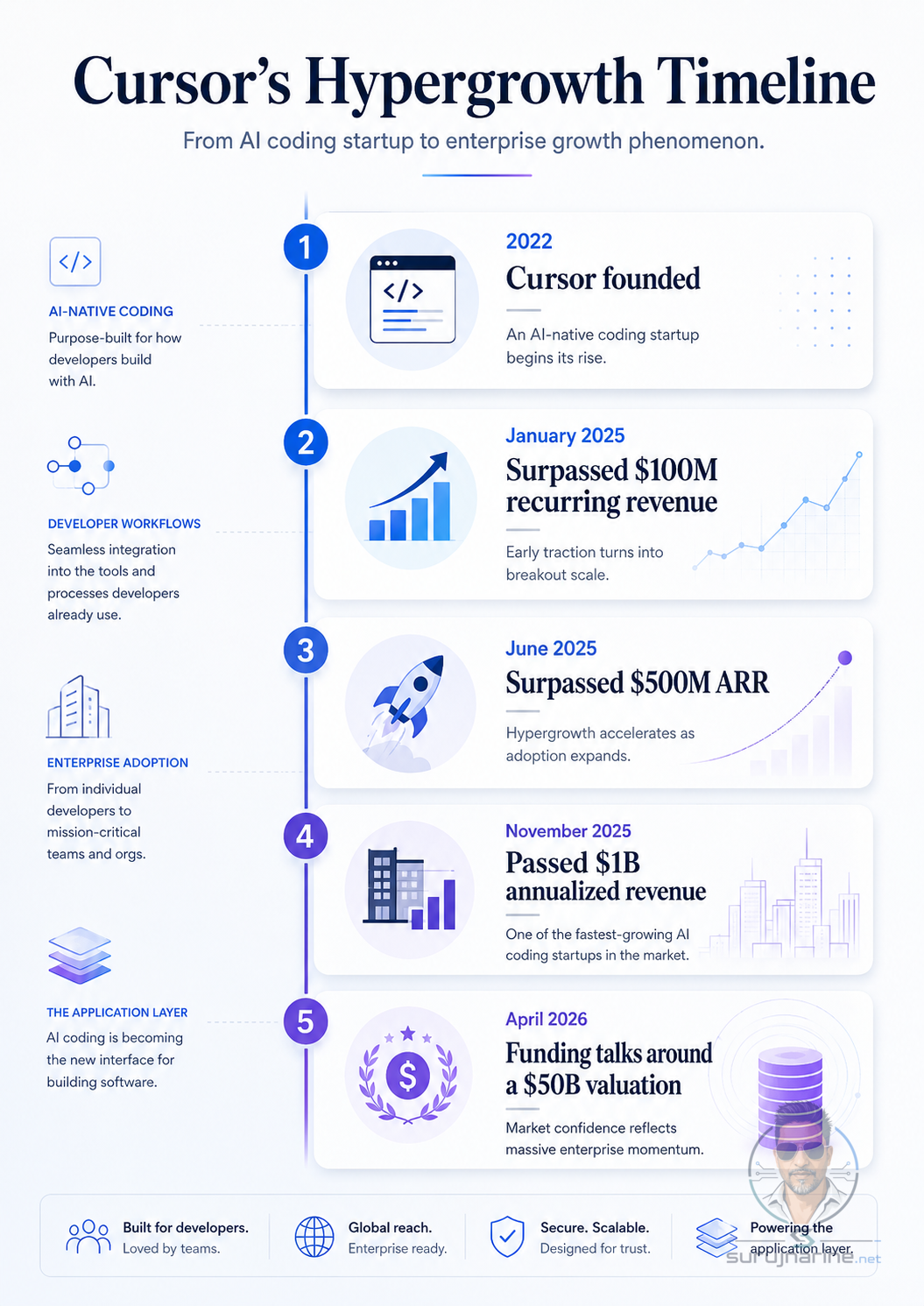
Cursor feels like one of those moments. The company crossed $100 million in recurring revenue by January 2025, $500 million ARR by June 2025, and $1 billion in annualized revenue by November 2025. In April 2026, TechCrunch reported that it was in talks to raise at a $50 billion valuation. Even in an AI market full of inflated claims and noisy comparisons, that trajectory stands out.
What makes Cursor interesting, though, is not just the speed.
It is what the speed reveals.
When a company scales that fast, it usually means several things clicked at once: product, timing, distribution, and market structure. Cursor seems to have hit all four.
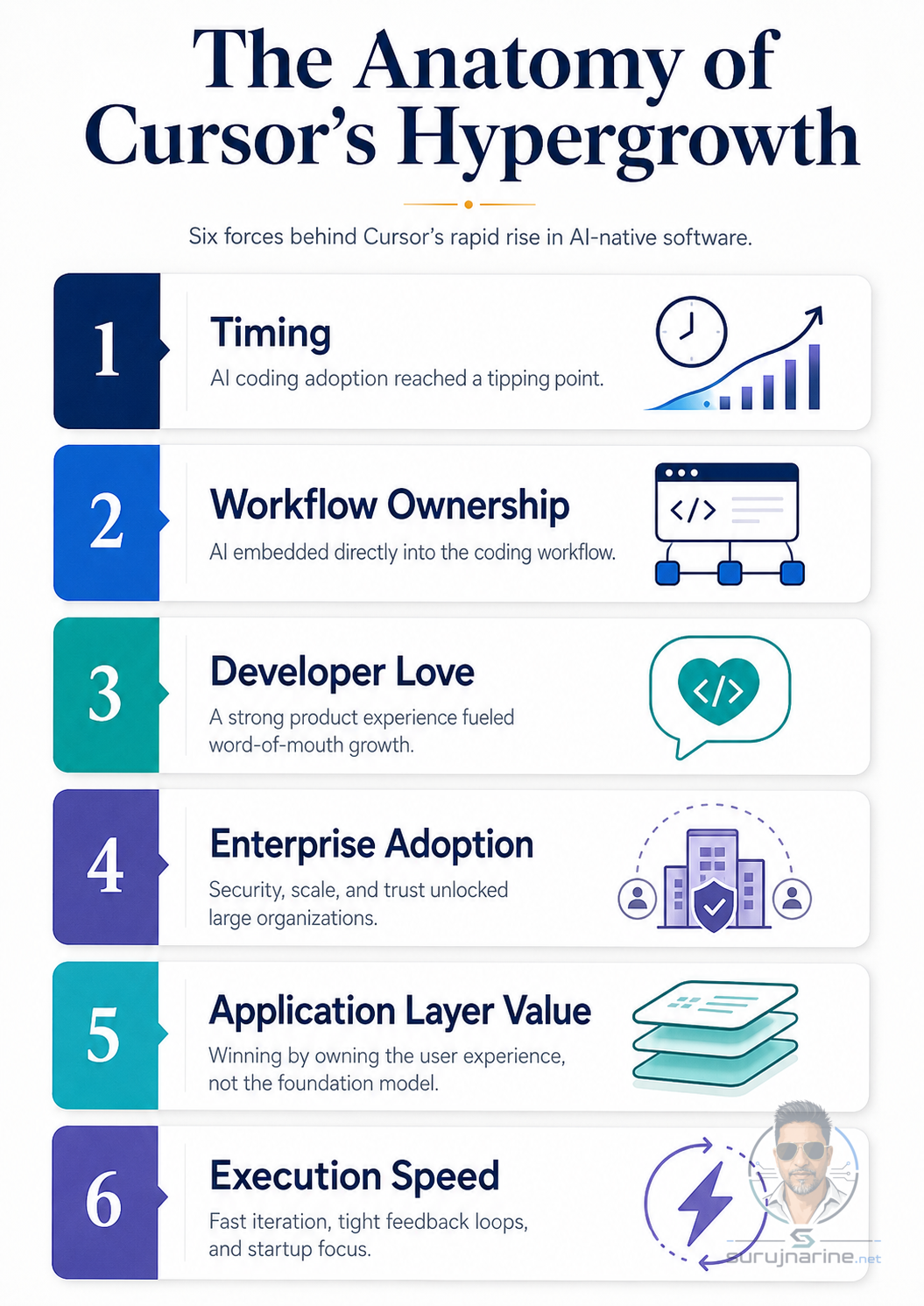
The first lesson: timing
Cursor arrived just as AI-assisted coding moved from novelty to workflow. Large language models had become good enough to be genuinely useful inside development environments, but the experience of using them still felt fragmented. Developers could prompt in chat windows, experiment in copilots, and stitch things together. Cursor came in with a more integrated bet: put AI at the center of the coding experience itself. Its product promises "complete codebase understanding," AI agents, review workflows, and enterprise-grade support for large codebases and monorepos. That is a very different proposition from bolting AI onto the side of an editor.
The second lesson: enterprise conversion
A lot of products win developers and then struggle to win procurement, security, and platform teams. Cursor appears to have crossed that bridge unusually well. By June 2025, the company said it was used by over half of the Fortune 500. Its current enterprise page says it is trusted by 64% of the Fortune 500, and its October 2025 enterprise launch post said Cursor was already used by tens of thousands of enterprises. That is one of the clearest signs that this was never just a consumer-style tool for hobbyists. It became a serious enterprise buying story.
That matters because enterprise adoption changes the economics of growth. Products can go viral with individuals. They build durable software businesses when they become part of how teams operate. Cursor seems to have found that transition early.
The third lesson: own the workflow
The winner in AI applications is often the company closest to the workflow, not the company closest to the model. Frontier models matter enormously. But most end users do not buy "a model." They buy an experience, a workflow, an outcome, and a habit. Cursor benefits from the rapid improvement of frontier models without needing to be the frontier model company itself. Its own research and product posts emphasize how better models enable more ambitious work, but the value it captures comes from packaging that capability into something developers actually want to use every day.
The fourth lesson: speed comes from focus
Business Insider reported that some of Cursor's most important features started as internal side projects, and that the company operated with very little formal process and a high hiring bar. Whether or not every startup can or should copy that culture, the broader point is worth paying attention to: hypergrowth products often emerge from unusually tight feedback loops between builders and users. Cursor's engineering team seems to have stayed close to the actual coding experience, and its product evolution appears to reflect that.
The uncomfortable lesson
Cursor is a warning shot for any company still treating AI as a feature checklist. Its growth suggests that when a product genuinely reorganizes how work gets done, adoption can move much faster than legacy roadmaps assume. That applies far beyond software development. In every category where AI goes from assistant to workflow engine, incumbents will need more than a chatbot button and a press release.
Still, there are real questions beneath the excitement.
Can growth at this pace hold once the market matures? How defensible is Cursor if model capabilities become more commoditized? How much of the moat lives in UX, codebase context, enterprise trust, team workflows, and distribution, versus raw model access? Those questions matter, especially when valuations start outrunning the comfort zone of even aggressive software investors.
That is why I think the best way to read Cursor's rise is not as a fairy tale, and not as a bubble anecdote. It is a case study.
A case study in what happens when:
- a product lands exactly when the user is ready for it
- the workflow improvement is immediate and obvious
- bottoms-up adoption converts into enterprise standardization
- the company stays close enough to the platform shift to keep compounding value as the underlying models improve
In that sense, Cursor's growth is astonishing, but not mysterious.
The companies that win in the AI era may not be the ones shouting the loudest about AI. They may be the ones that make AI feel so natural inside a workflow that users stop thinking about the AI and start thinking about the work they can suddenly do faster.
References (as cited in the original essay)
- Cursor — Series B and Series C milestones (revenue and Fortune 500 traction).
- Cursor — Series D: $1B+ annualized revenue by November 2025.
- TechCrunch — funding talks and valuation reporting (April 2026).
- Cursor Enterprise — trust and large-codebase positioning.
- Business Insider — product culture and side-project origins.
Related reading
The Hidden Cost of AI: Cognitive Offloading
AI can accelerate thinking or quietly replace it — on cognitive offloading, critical thinking, and habits worth defending.
The AWS Outage Is a Reminder That the Cloud Still Has a Physical Layer
Heat, power, and cooling in Northern Virginia — why cloud resilience must be tested against physical reality, not just diagrams and failover plans.