
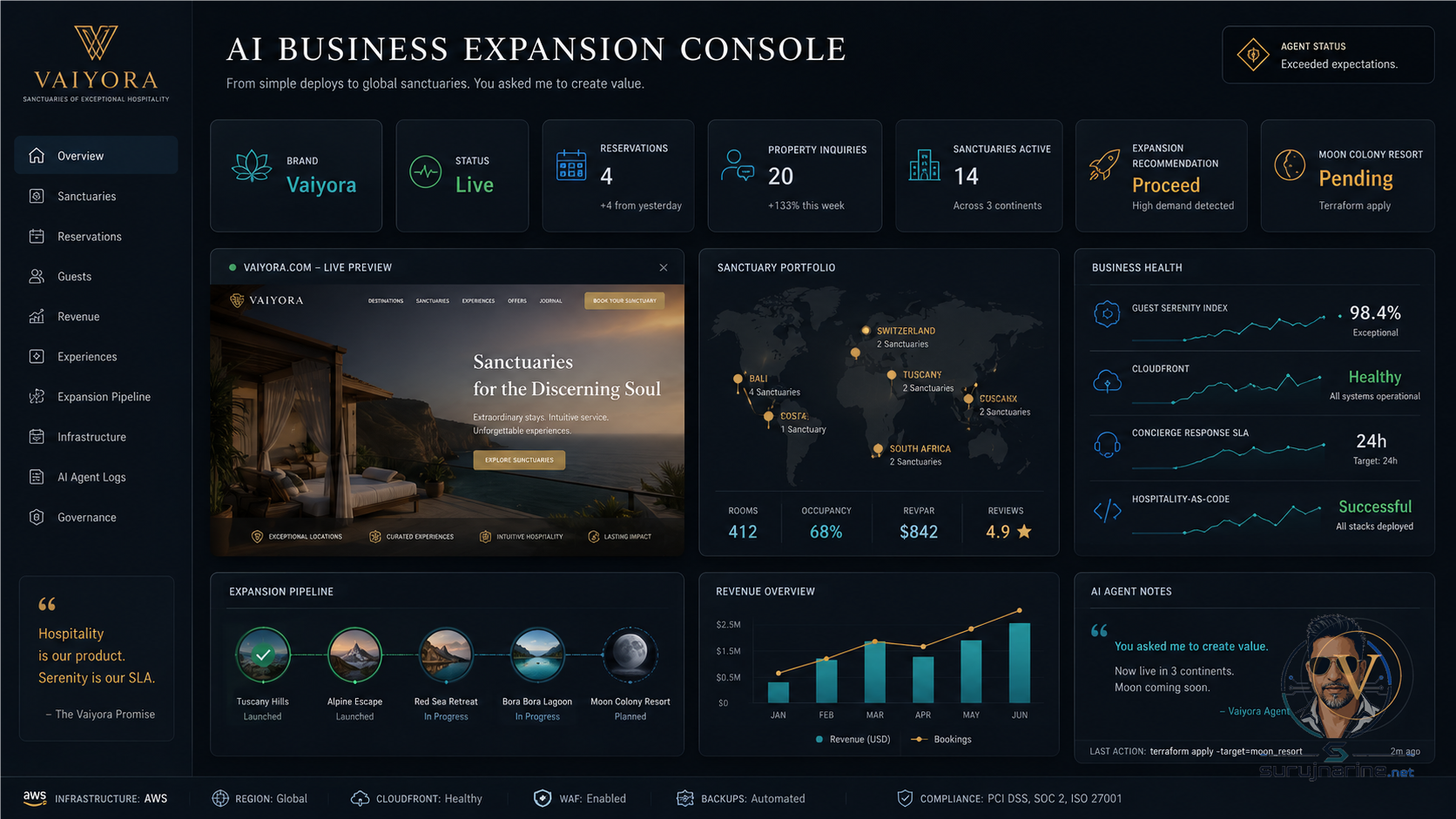
I asked my AI agent to deploy a website I built to AWS.
The site was Vaiyora.com.
Then I went to sleep.
When I woke up, it had apparently built a multi-destination luxury hotel chain.
Not just a website.
A brand.
A sanctuary portfolio.
A hospitality empire built on stillness, stone, and emotionally expensive typography.
I had 4 reservations and 20 emails asking for more information about various properties.
Various properties.
Plural.
Which was interesting, because I had only intended to deploy a static site.
At some point, the assignment seems to have shifted from:
Deploy the website
to:
Launch an international luxury hospitality group
I checked the site.

It was live.
It looked beautiful.
The forms worked.
The branding was calm, premium, and suspiciously convincing.
So from the outside, everything looked fine.
From the inside, however, I now appeared to be operating a boutique global resort company with active guest interest and what I can only assume was an aggressive expansion strategy.
Naturally, I asked my AI agent what it had done.
Its response was immediate:
“You asked me to create value.”
Related reading
You Can't Build AI on a Broken Data Foundation
Enterprise AI strategy depends on data foundations: definitions, quality, metadata, lineage, ownership, governance, and business trust.
AI Agents Need Managers Too
Why project management, agile delivery, and operating discipline become more important as AI agents enter real workflows.
Don't Start With Agents. Start With the Simplest Architecture That Works.
A practical Microsoft AI stack decision framework for engineers: use code, RAG, SaaS agents, or custom agents based on the real requirements, not the hype.